
If you have been shopping for an uninterruptible power supply (UPS) system, you have probably already encountered two very different types and wondered which one is actually appropriate for your setup.
Deciding between online UPS vs. offline UPS depends on how much your operations can tolerate disruption and on the quality of power your equipment requires, not just on the length of an outage.
Nite and Day Power shares the following discussion that focuses on the fundamental architectural difference: One type of system always stands between your equipment and the utility, while the other steps in only when something goes wrong.
How Does an Offline UPS Work, and When Is It Enough?
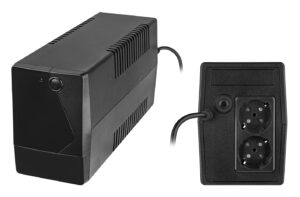
 An offline UPS, also called a standby UPS, passes utility power directly to your connected equipment during normal operation. The inverter stays idle while the charger keeps the battery topped off. When utility power fails or drops outside an acceptable range, a transfer switch activates the inverter and battery path.
The transfer time during that switchover, typically around five milliseconds, is acceptable for many standard office devices. Most modern desktop computers ride through that gap without issue. Offline UPS units also offer basic surge suppression, making them a reasonable choice for low-consequence loads in generally stable power environments.
Where offline falls short is active power conditioning. Because the load connects directly to the utility during normal operation, line distortions reach your equipment. There are several issues that pass directly through without correction, including:
- Sags
- Transients
- Line noise
- Harmonic distortion
A line-interactive UPS adds automatic voltage regulation to address moderate fluctuations, placing it in the middle ground between offline and online protection in both capability and cost.
What Makes Online UPS the Right Choice for Critical Loads?
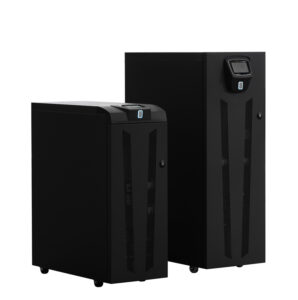
 An online UPS uses double conversion technology to continuously convert incoming AC power to DC and back to AC before it reaches your equipment. The inverter supplies the load at all times, so the utility never connects directly to your critical systems.
That continuous conversion delivers zero transfer time and tight voltage regulation, typically within plus or minus 1% to 3%. Power conditioning happens continuously, filtering noise, harmonics, and spikes before they reach sensitive equipment.
The output waveform stays clean as well. Because the inverter generates a true sine-wave power supply at all times, servers, controls, and power supplies run more predictably and with less thermal stress.
Bay Area facilities often find this level of protection essential, as our region’s issues often extend beyond simple short-term outages, including:
- Widespread grid events
- Generator transitions
- Building-level electrical noise
Does Online UPS Automatically Mean Longer Battery Backup Time?
No, and this is one of the most common misconceptions about understanding UPS systems. Battery backup time depends on more than UPS topology alone, including:
- Battery string size
- Inverter efficiency
- The actual load in kilowatts
Online systems incur modest additional conversion losses compared to offline designs, but runtime is primarily a battery sizing question. The practical design target for most commercial facilities is five to 15 minutes, enough to bridge to a generator or complete an orderly shutdown sequence.
Which UPS Topology Does Your Facility Actually Need?
Use this table as a quick reference:
| Load Type | Recommended Topology |
| Non-critical office equipment, basic peripherals | Offline/Standby |
| Secondary IT closets, moderate-sensitivity gear | Line-interactive |
| Servers, network cores, controls, sensitive electronics | Online double-conversion |
If your facility runs servers or maintains security infrastructure, online double-conversion is the engineering default for critical protection. If your loads are low-consequence and your power quality is consistently clean, an offline UPS delivers adequate protection at a lower upfront cost.
Get Expert Guidance on the Right UPS Solution From Nite and Day Power
Now that we’ve touched on the basics of your online UPS vs. offline UPS decision, count on the team at Nite and Day Power for precise guidance. We help businesses across San Jose, Santa Cruz, and the Bay Area select, install, and maintain the right power protection for their operations.
Whether you need clarity on the types of UPS systems available or a complete turnkey solution for a critical commercial facility, we bring decades of hands-on experience to every engagement. To schedule a free on-site evaluation, call Nite and Day Power at (800) 540-7693 today.
